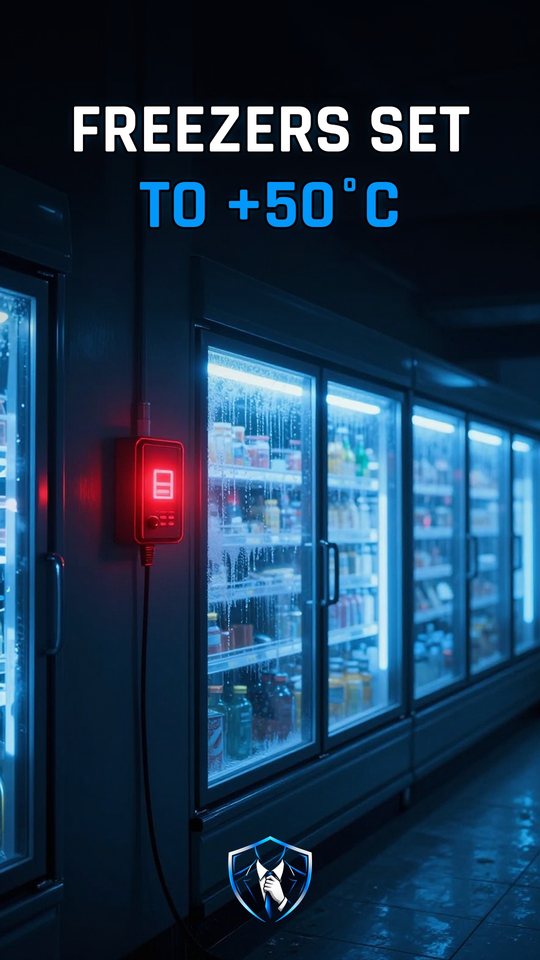
How did hackers make supermarket freezers heat up?
Hackers reached freezer controllers whose web pages sat on the open internet, got past the login, and forced on defrost, a normal heating feature, so cold cases warmed up overnight.

Supermarket freezer hack
On November 2, 2026, more than 115 supermarkets in six European countries found their freezers shut down or defrosting. In some stores in Sweden and Estonia, units were set to plus 50 degrees Celsius. The stores were in Belgium, the Netherlands, Sweden, Luxembourg, Ireland and Estonia. Each store’s cold cases are run by a control computer called a system manager. Examples include the Danfoss AK-SM and AK-SC and the Copeland/Dixell XWEB. Nobody has claimed responsibility, and no culprit has been named.
The safer setup is simple. The controller’s web page should not sit on the open internet. France’s CERT-FR (Computer Emergency Response Team) says to remove that internet exposure and allow access only through a VPN (Virtual Private Network). It also says to update the firmware and change default passwords. Repair firms can still work remotely, but the login page is no longer open to the whole internet.
What a system manager actually does
A system manager is the store’s refrigeration control box. It has a web page for temperatures, defrost and alarms. So repair firms can work remotely, that page often sits on the store’s internet line. Anything on the internet can be found. Shodan, a search engine for devices, lists over 4,500 Danfoss controller login pages. MITRE ATT&CK for ICS (Adversarial Tactics, Techniques, and Common Knowledge for Industrial Control Systems) calls this T0883, Internet Accessible Device.
How the attack chain works
- The page is online. The controller’s web page is reachable from the internet so technicians can log in from afar.
- Scanners list the logins. Device search engines like Shodan catalog these login pages, so finding thousands of targets takes no effort.
- Getting past the login. The exact method is not public. Many boxes are discontinued: the AK-SM 800 has been end of life since May 2021, and Danfoss said most affected units were legacy models with no updates. One known flaw,
CVE-2025-41450(Common Vulnerabilities and Exposures), let anyone calculate a hidden password from the date and time on AK-SM 8xxA units before version R4.2. It’s an example of a known flaw, not proof of how this attack got in. - Defrost forced on overnight. Defrost is a normal feature that heats iced-up coils. Forcing it on is
T0836, Modify Parameter. One ICA franchise store was hit at 2 a.m.
The result is an attack that needs no malware. Changing a setting through the controller’s own interface is enough to warm the cold cases while nobody is watching. The MITRE IDs here map the type of attack. They are not an official attribution.
A factory reset is not a fix
It’s tempting to think wiping the controller ends the problem. A factory reset of an exposed, unpatched, end-of-life device does remove what the attackers left behind. But CERT-FR says such a device will almost certainly be compromised again. The login page is still on the internet, and the flaw is still there. The real fix is to close the exposure, not to reset the box.
What to do
- Open your router’s settings page today and delete any port forwarding rule you don’t recognize. That rule is how a camera or NAS (Network Attached Storage) gets exposed to the internet.
- Use one simple test: if you can reach a device from the internet, so can every scanner.
- If you manage a store or building, take controller web pages off the internet and allow remote access only through a VPN.
- Update the firmware and change default passwords on any controller you manage.
Watch it in 60 seconds