
Cybersecurity
Firewalls, encryption, authentication, and the people and tools that defend networks every day.
Courses
Linux Fundamentals
The command line, files, users, and permissions.
Start the courseBlue Team and SOC Analyst Basics
Read logs, write detections, triage alerts.
Start the courseIncident Response and Digital Forensics
Plan, preserve evidence, investigate, and report.
Start the courseKali Linux
An isolated lab and the core tools, in your own lab only.
Start the courseEthical Hacking (legal labs)
How attacks work, practiced only in your own lab.
Start the courseVideos
22 explanations, easiest first
How does two-factor authentication (2FA) work?
Two-factor authentication (2FA) asks for a second proof on top of your password: something you have, like your phone. An attacker who only has your password stays locked out.
How does Active Directory sign you in at work?
Active Directory is a company's list of every user, computer and group, and at sign-in it uses Kerberos to prove who you are without your password ever crossing the network.
Is it safe to keep your passwords in your browser?
Yes, on your own devices. Chrome and Safari encrypt your passwords in a vault, but that vault is only safe if your device and your account are.
How does the CIA triad work?
The CIA triad is the core model of information security: confidentiality (only authorized people can read the data), integrity (nobody changes or deletes it without permission) and availability (it's there when you need it).
What is DLP and how does it spot data leaks?
DLP (data loss prevention) is software that checks what leaves a company, like an email or a USB copy, and warns or blocks when it matches sensitive data such as card numbers.
What is EASM and how does it find forgotten servers?
EASM (External Attack Surface Management) is defenders mapping their own internet-facing systems from public records, the way an attacker would, so forgotten servers get found and checked.
How is XDR different from EDR?
EDR (endpoint detection and response) records what happens on each device. XDR (extended detection and response) adds email, sign-ins and cloud apps and joins it all into one incident.
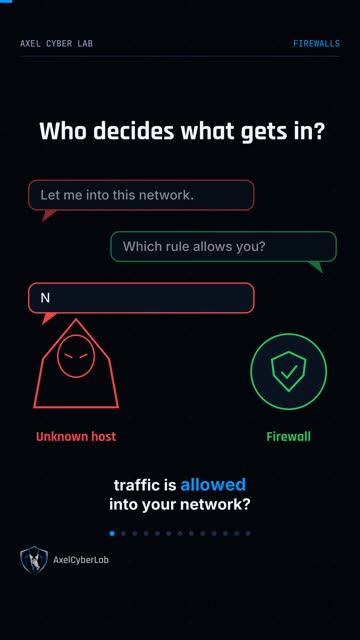
What is a firewall?
A firewall is a security system that sits between networks or devices and allows or blocks traffic by checking each packet against a list of rules.
What is a honeytoken and how does it catch hackers?
A honeytoken is a fake secret, like a passwords file or a cloud key, planted on purpose. Nobody legitimate touches it, so any touch means an intruder and sends you an alarm.
How is an IPS different from an IDS?
An IPS (intrusion prevention system) sits in the traffic's path and drops a matching packet. An IDS (intrusion detection system) only reads a copy and writes an alert after the packet has passed.
How do you protect a NAS from ransomware?
Protect your NAS (Network-Attached Storage) by always keeping it up to date: bots search the internet for NAS devices with a known flaw that hasn't been fixed.
How can a network detect a hacker?
NDR (Network Detection and Response) watches a network's traffic, learns what's normal, and raises an alert when a device calls a server on a schedule that's too regular.
Is a password manager actually safe to use?
Yes, for most people: a password manager makes a different random password for every site and keeps them encrypted, so one leak can't unlock your other accounts.
Why is SFTP safer than FTP?
SFTP (SSH File Transfer Protocol) is safer because every command and file travels inside one encrypted SSH (Secure Shell) connection, while plain FTP sends your password and files as readable text.
What is a SIEM and how does it detect attacks?
A SIEM (Security Information and Event Management) is a central system that collects logs from laptops, servers, firewalls and cloud apps, and runs rules on them to raise alerts about possible attacks.
What is UEBA and how does it spot odd sign-ins?
UEBA (User and Entity Behavior Analytics) is software that learns what's normal for each person and device, then flags activity that doesn't fit, even when the password is correct.
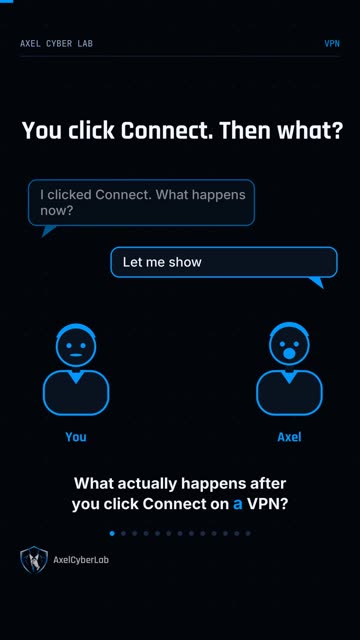
What is a VPN?
A VPN (Virtual Private Network) is an encrypted tunnel between your device and a VPN server, which then forwards your traffic to the internet using its own IP address.
What is Zero Trust security and how does it work?
Zero Trust is a security model where being on the network earns no automatic trust: every request is checked against who you are, your device and the risk, every time.
How does DNSSEC prove a DNS answer is real?
DNSSEC (Domain Name System Security Extensions) signs DNS answers. A validating resolver checks those signatures from the root down and rejects a forged address, as long as the domain is signed.
Why do hackers want your graphics card?
A GPU (Graphics Processing Unit) runs thousands of threads at once, so attackers use it to test billions of password guesses a second against stolen hashes offline, or hijack it to mine crypto.
What happens when the root DNS key changes?
When the root Key Signing Key (KSK) changes, every validating DNS server must already trust the new key, or it fails every lookup, because all DNSSEC signatures trace back to that one key.
How do SSL/TLS certificates prove who a website is?
A TLS (Transport Layer Security) certificate is a website's digital ID: it proves the server holds the private key for a domain name, but never that the people behind that name are honest.
Roadmaps that cover cybersecurity
Cybersecurity from Zero
Start with how the internet actually works, then secure your own accounts and devices before learning how attackers think. Each stage mixes short explanations, small tools, and safe hands-on tasks on your own computer.
Networking Fundamentals
Networking is the foundation under almost every security skill. This path takes you from addresses and names to models, home networks, secure traffic, and finally reading real packets on your own machine.
SOC Analyst
Learn how a Security Operations Center detects and responds to threats. You will build a small home lab, read real logs from your own machines, map activity to MITRE ATT&CK, and practice the incident response process.